
I Want Your Sex-Araki Returns, But He Brought Condoms (Review)
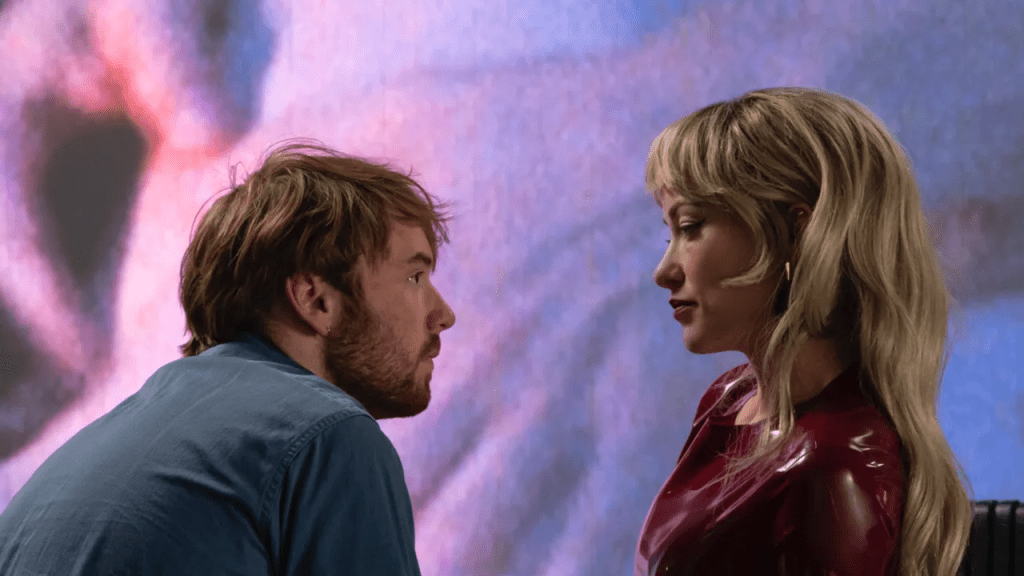
‘I Want Your Sex’
Twelve years have passed since Araki last helmed a feature film, returning to the screen with ‘I Want Your Sex’, his most accessible and safest movie yet. Part BDSM-comedy, part procedural parody, the film follows Elliot, a reserved and sexually stunted young man who falls for high art icon, Erika, quickly becoming her sexual muse, exploring sex in ways he hasn’t before. When this film was making its rounds around the critic circles, it felt clear that Araki was attempting to tackle something that comes up a lot amongst discourse of Gen Z’s consumption, ”Why is Gen Z so prudish”. All over online social circles, I find myself seeing back and forth arguments about sex in film and TV, primarily the issue, or non-issue, of “unnecessary sex scenes”. Gen Z has consistently shown their standoffs when it comes to sex, both in the media they consume, and in real life. Sex feels like a taboo, something you keep to yourself, and don’t express.
Anyone familiar with Araki’s works understands that he doesn’t shy away from tackling such taboo, beautifully handling and challenging such topics with his works like “Mysterious Skin” and “The Doom Generation”. Going into “I Want Your Sex”, one anticipates him to get to the root of Gen Z’s sex habits…but his accessible approach ultimately hinders the film.
See, the film doesn’t actually seem all too interested in exploring and answering those questions, no, it uses it as the crutch of the story. Elliot is Gen Z, he has a girlfriend who very clearly doesn’t like him, with sex being few and far between, and the very one-sided. His best friend, Apple, hasn’t had sex in over a year, and makes it pretty known she’s a bit hesitant towards it in general. Elliot’s gay coworker, Zap, is the only one who explores and shares his sexuality, being open with Elliot about his experiences.
Enter Erika, an artist who’s made herself a sort of artsy sexual icon, constantly platforming sex and sexuality in her works and exhibitions. She’s much older than him, and serves almost as Araki’s insertion of trying to understand Gen Z. When Elliot begins his relationship with her, he’s opened up to a world of new kinks and pleasures, being free to explore himself and express himself without fear of judgment. As the film intercuts with his interrogation, it’s obvious being sexually liberated has him not feeling ashamed of who he is, even when he knows the detectives interrogating him don’t understand.
I do find that Araki handles Elliot’s exploration of sexuality and then his exploitation by Erika quite well. Through Cooper Hoffman’s wonderful performance, we see the nuances of Elliot as the former shell of who he was, the barrier he was hiding behind, is slowly peeled back, elevated by Hoffman’s facial ticks and eyes. You can see the confidence slowly grow in him, as well as his understanding that he’s slowly becoming taken advantage of.
The way Araki frames Olivia Wilde as Erika, constantly having her dominate the frame (and Elliot), the camera lingering on her, as we ogle her through Elliot’s eyes, it all works to make us fall for her just as he does, and then proceed to find her disgusting and controlling.
That being said, I also found the film’s cinematography and production a bit of a hindrance. Switching from film to digital seems like an easy cop-out, but you can see where that choice is lacking. The film isn’t ugly, in fact it has quite saturated colors and the set designs match the aesthetic of the artsy world it takes place in, especially in Apple’s apartment and Erika’s studio, but none of it feels all too memorable or set apart from other films that have come out this year.
I can’t not mention the needledrops, Araki substitutes his trademark shoegaze for more of the times pop, which never quite landed or stuck with me after, which I did find disappointing. The lack of notable needle drops reminded me just how well Jane Schoenbrun’s “I Saw the TV Glow” kept his signature sound going, what a soundtrack.
Because of the overall direction it takes, this feels like Araki’s safest film yet. It doesn’t get quite weird and out of place as I’m used to with his other works, but that doesn’t mean his signature flairs aren’t here. There’s scenes sprinkled out that feel cartoony and pretty out there, which sometimes works for laughs, but often can feel cringe instead. He did have a co-writer for this one, Karley Sciortino, who is notable for founding Slutever, a website that focuses on exploring sex and sexuality. I’m unsure how much each had a hand in developing the script, but outside of Elliot and Erika, the supporting cast of characters don’t feel fully fleshed out, instead being more your cliche caricatures, especially Zap, the typical gay best friend, who feels one-dimensional, and Apple, who actually becomes one of the more interesting characters but is forgotten about after the middle act.
With all that said, I still found it to be very entertaining, bordering from liking it to loving it! The script is brought to life exceptionally by Hoffman and Wilde, both surprising me by just how good they both handled such complex characters. Their performances alone make this one of my favorites of the year, despite its glaring flaws, which sometimes feel like me being nitpicky
“I Want Your Sex” doesn’t aim to answer “Why isn’t Gen Z fucking?” but instead to show Gen Z that sex isn’t something to be ashamed of. In an already overgrown social climate, where social media has become a constant performance, Araki wants Gen Z to step back and just live, to find themselves outside of the black mirror.
Score: 4 out of 5!
Follow me on Letterboxd!

